

- What Are the Big Five, and Why Are They Called That?
- The Big Five, One by One
- Where Can You See All Five in One Trip?
- When Is the Best Time to See the Big Five?
- Ranking the Big Five by Difficulty
- Why the Guide Makes or Breaks a Big Five Safari
- Big Five Conservation: The Honest Picture
- How to Plan Your Big Five Safari
The Big Five are the lion, leopard, African elephant, rhinoceros, and Cape buffalo. The name has nothing to do with size. It came from colonial-era hunters who ranked these as the five most dangerous animals to hunt on foot. Today the phrase belongs to safari-goers rather than hunters, and seeing all five on a single trip is one of the great milestones of an African adventure. Kenya, Tanzania and South Africa are the classic countries to do it. In Kenya, the Maasai Mara, Ol Pejeta Conservancy and Lake Nakuru together give you a strong shot at the full set, while in Tanzania the Serengeti and Ngorongoro Crater do the same. The hardest of the five to find is almost always the leopard.
That is the short version. Below is everything we have learned guiding guests to these animals over the years: what each one is really like in the wild, where your odds are best, when to go, and how to plan a trip that actually delivers.
What Are the Big Five, and Why Are They Called That?
Let us clear up the most common misconception first. The Big Five is not a list of Africa’s biggest animals. If it were, the hippo and the giraffe would make the cut and the leopard would not come close.
The term is a hunting inheritance. In the late nineteenth and early twentieth centuries, professional hunters used “the Big Five” to describe the five species that were the most difficult and dangerous to hunt on foot, the ones most likely to turn and charge when wounded. Lion, leopard, elephant, rhino and Cape buffalo earned that reputation through a mix of aggression, unpredictability and sheer power.
The label stuck, but its meaning flipped. What was once a hunter’s trophy checklist is now a photographer’s bucket list, and the tourism industry adopted it wholesale. You will see it on lodge signboards, park brochures and just about every safari itinerary in East and Southern Africa, including ours. Spotting all five is still a genuine achievement, not because they are rare in an absolute sense, but because they keep different company, favour different terrain and, in the leopard’s case, actively avoid being seen.
A quick note on the “Small Five,” because guests always ask. It is a tongue-in-cheek counterpart made up of the elephant shrew, ant lion, rhinoceros beetle, buffalo weaver and leopard tortoise. A good guide will happily point them out once you have had your fill of the originals.
The Big Five, One by One
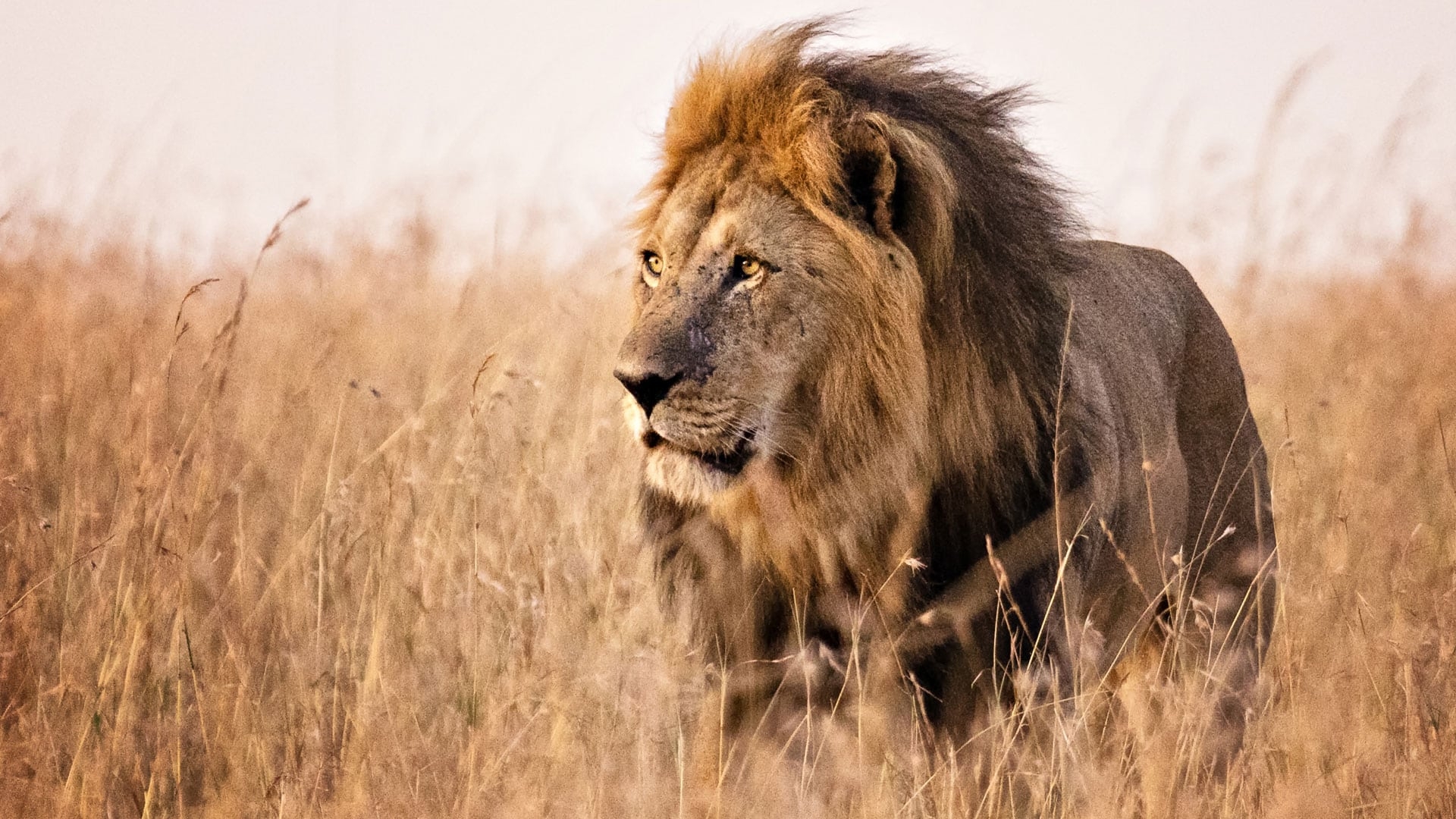
Lion (Panthera leo)
The lion is the animal most people picture when they close their eyes and think “safari,” and it rarely disappoints in person. What surprises first-timers is how much of a lion’s day is spent doing almost nothing. Up to 20 hours of rest is normal. The drama comes in flashes: a coordinated hunt at dusk, a territorial roar that carries for miles, cubs testing the patience of a lame-legged uncle.
Lions are the only truly social cat, living in prides that can range from a handful of animals to twenty or more. In the Maasai Mara and the Serengeti, prides organise their lives around the great herds of the migration, and the hunting we witness there is some of the most reliable on the continent.
The conservation picture is sobering. Fewer than an estimated 25,000 wild lions remain across Africa, and some conservation groups put the figure closer to 20,000. The species is listed as Vulnerable on the IUCN Red List. Lions now occupy less than 8 percent of their historic range, and populations have fallen by roughly a third in two decades. More than half of what is left lives in just a few countries, with Tanzania holding by far the largest share. When you sit with a pride in the Mara, you are looking at a species under real pressure, which is part of why we invest in the conservancies we do.
Where we find them for guests: the Maasai Mara and the wider conservancies in Kenya, the Serengeti and Ngorongoro in Tanzania, and the private reserves bordering Kruger in South Africa, the Okavango Delta in Botswana, Lower Zambezi in Zambia, and Hwange in Zimbabwe.
Leopard (Panthera pardus)
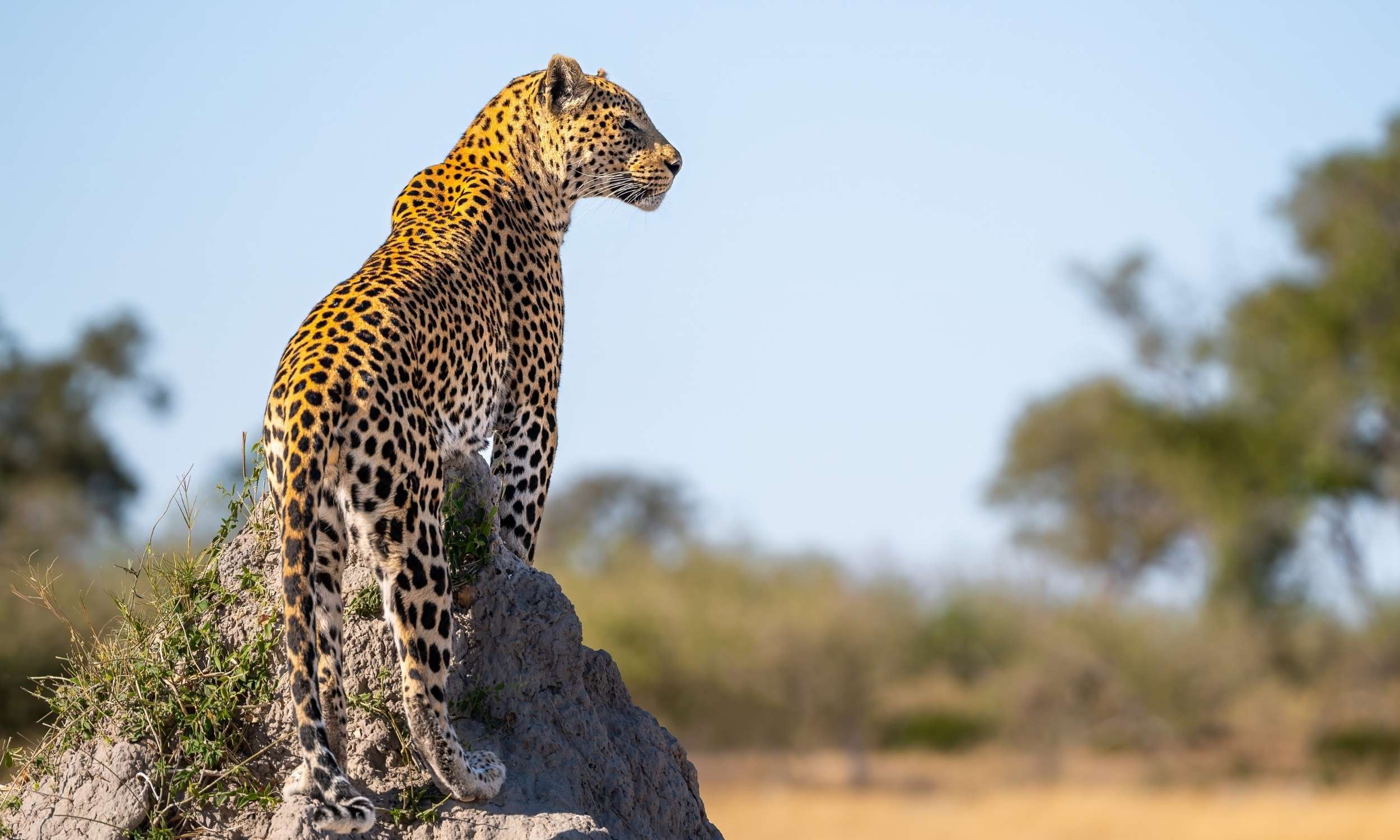
If the lion is the icon, the leopard is the prize. Ask any guide which of the Big Five is hardest to show a guest, and you will get the same answer nine times out of ten. Leopards are solitary, largely nocturnal and masters of camouflage. This is a big cat that can be lying fifteen metres away in dappled shade and simply not be there until it moves.
They are also the most adaptable of the great cats, which is why counting them accurately is so difficult and why range-wide population figures should be treated with caution. Leopards live across an enormous span of habitats, from rainforest to semi-desert, and they are the only Big Five member you have a realistic chance of seeing outside a formal reserve. The IUCN lists them as Vulnerable, with numbers declining, but the honest answer to “how many are there?” is that nobody knows precisely.
The trick to leopard sightings is habitat and patience. We look to riverine woodland, rocky kopjes and the big fig and sausage trees where a leopard will drape itself along a branch, often with a kill hauled up out of reach of lions and hyenas. Some corners of Africa have turned leopard-viewing into an art form. The private conservancies of the Sabi Sand in South Africa, and Botswana’s Okavango, are famous for relaxed, habituated cats.
Where we find them for guests: the Sabi Sand in South Africa, South Luangwa in Zambia, the Okavango Delta in Botswana, and the tree-lined rivers of the Maasai Mara and Serengeti.
African Elephant (Loxodonta)
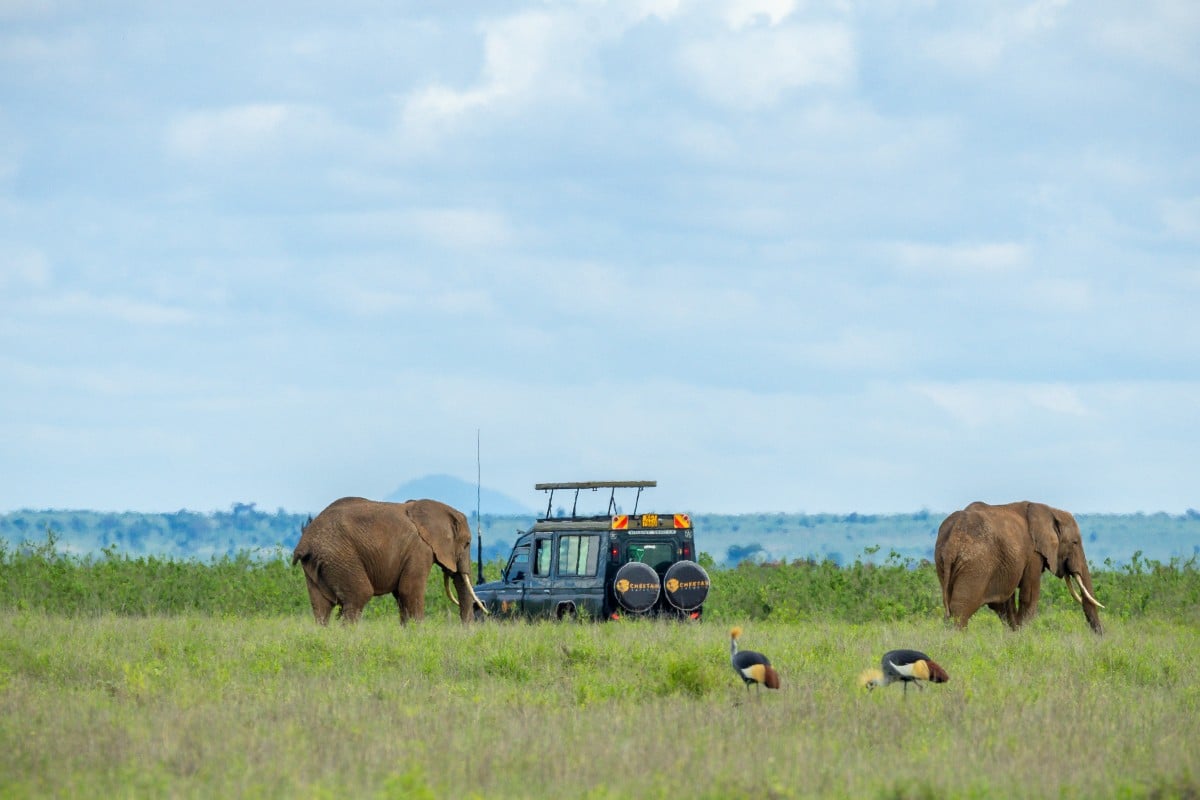
Nothing quite prepares you for the scale of a bull elephant a few metres from the vehicle. They are the largest land animals on Earth, and yet what stays with most of our guests is not the size. It is the intelligence and the family bonds. Herds are led by a matriarch, the oldest and most experienced female, whose memory of water sources and migration routes can be the difference between survival and disaster in a dry year.
Here is something worth knowing that has changed recently. Scientists now recognise two separate African elephant species rather than one. The African savanna elephant (Loxodonta africana) is the one you will see on almost every classic safari, the big-eared giant of the open plains, and it is listed as Endangered. The African forest elephant (Loxodonta cyclotis), smaller and darker, lives in the rainforests of Central and West Africa and is listed as Critically Endangered. A 2024 DNA-based survey, the first to assess the forest species on its own, put its numbers at roughly 135,690, with about two-thirds of them living in Gabon alone.
Savanna elephants are doing better in the strongholds of southern Africa. The transboundary KAZA region, which straddles Botswana, Namibia, Zambia, Zimbabwe and Angola, holds well over 200,000 of them, the single largest population on the continent. In East Africa, Amboseli’s elephants have been studied continuously for more than five decades and are among the best-known wild elephants anywhere. Watching a herd cross the plains beneath Kilimanjaro is, for many of our guests, the defining image of an African safari.
Where we find them for guests: Amboseli and Tsavo in Kenya, Tarangire in Tanzania, and Chobe and the Okavango in Botswana.
Rhinoceros (Black and White)
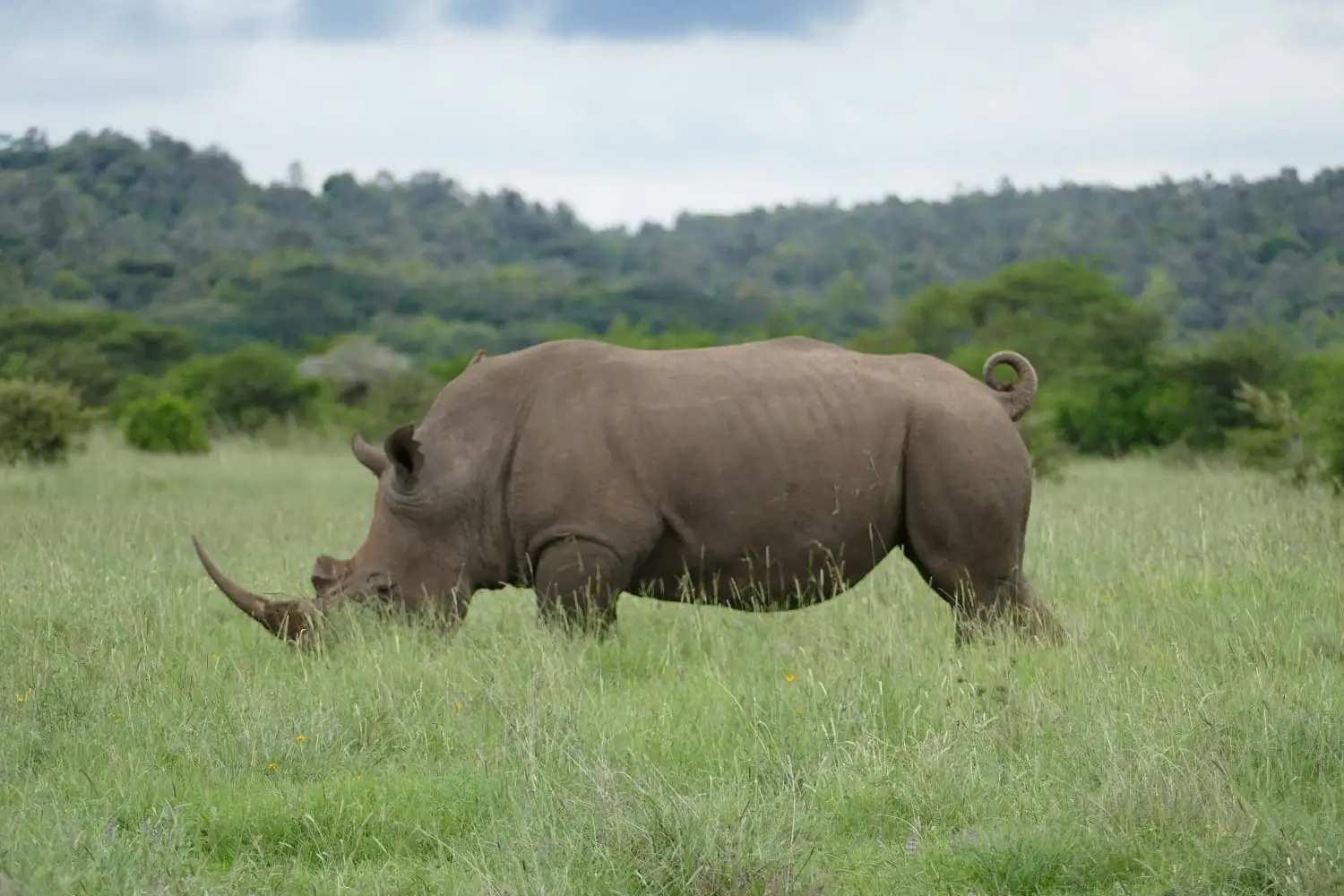
Africa has two rhino species, and telling them apart is easier than the names suggest, because the colours are misleading. Both are grey. The name “white” rhino likely comes from a mistranslation of the Afrikaans and Dutch word wyd, meaning “wide,” a nod to its broad, square lip built for grazing grass. The black rhino has a hooked, prehensile upper lip for browsing leaves and twigs, and a reputation for a shorter temper.
Rhinos are the Big Five member most shadowed by the poaching crisis, and the numbers tell the story plainly. At the end of 2024, Africa held an estimated 22,540 rhinos in total, roughly 6,788 black rhinos and 15,752 white rhinos. There is cautious good news and bad news inside those figures. Black rhino numbers, listed as Critically Endangered, rose by 5.2 percent in a single year, with Kenya and Zimbabwe among the recovery success stories. White rhinos, listed as Near Threatened, declined over the same period, largely because of poaching pressure in southern Africa.
The starkest reminder of what is at stake lives in Kenya. At Ol Pejeta Conservancy, the last two northern white rhinos on Earth, a mother and daughter named Najin and Fatu, both female, are protected around the clock by armed rangers. Their subspecies is functionally extinct, and the only hope of survival now rests on advanced reproductive science. We take guests to see them, and it is a quiet, sobering stop on any Kenyan itinerary.
Ol Pejeta is also one of the best places in East Africa to see black rhinos in reasonable numbers, and Lake Nakuru offers reliable white rhino sightings. In South Africa, the Kruger ecosystem and Hluhluwe-iMfolozi remain rhino heartlands, though both operate intensive anti-poaching and dehorning programmes.
Where we find them for guests: Ol Pejeta, Maasai Mara, Nairobi National Park, and Lake Nakuru in Kenya, Ngorongoro Crater in Tanzania, and the Kruger reserves in South Africa.
Cape Buffalo (Syncerus caffer)
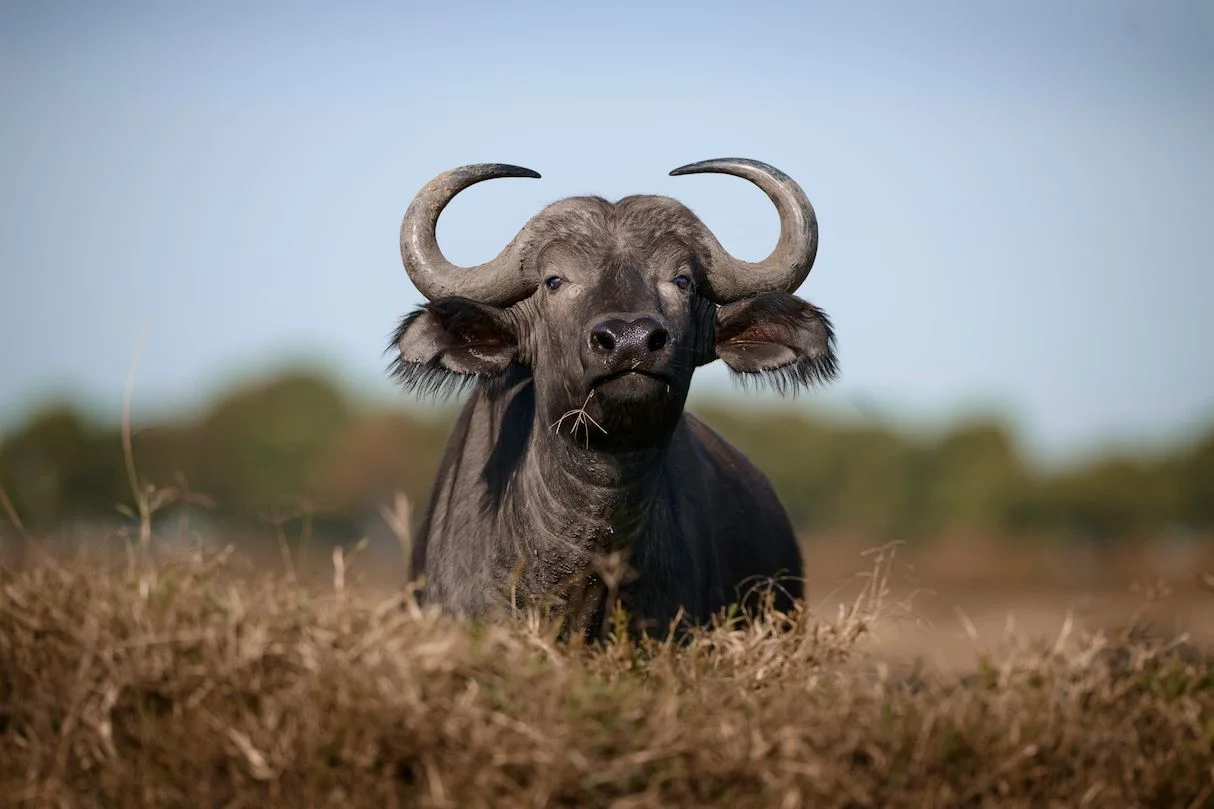
The buffalo is the one guests underestimate, right up until a guide explains why old bulls are nicknamed “the Black Death” and “the widowmaker.” Of all the Big Five, the Cape buffalo has arguably the most fearsome reputation for turning on hunters and vehicles, and there is a wariness in its eyes that is hard to forget. The old line among guides is that a buffalo looks at you like you owe it money.
Ecologically, it is the good-news story of the group. The Cape buffalo is listed as Least Concern, with the largest and healthiest populations of any Big Five species, several hundred thousand across the continent. They live in herds that can number in the hundreds or, on the Serengeti and in places like Katavi, occasionally over a thousand. That density makes them a dependable sighting, and the herds are a spectacle in their own right: a wall of horns and dust moving across the plain, egrets riding on their backs, lions shadowing the edges.
Solitary old bulls, the “dagga boys” caked in dried mud, are the ones to respect and the ones lions test most often. Some of the most gripping predator-prey standoffs we have watched have been a buffalo herd rounding on a lion pride to rescue a calf.
Where we find them for guests: every major East and Southern African park, from the Maasai Mara and Serengeti to Kruger and Chobe.
Where Can You See All Five in One Trip?
This is the question we are asked more than any other, so here is a straight answer. A handful of destinations give you a genuine chance at the complete set, and the right choice depends on how much time you have and what else you want from the trip.
- Kenya is our home ground and a strong all-rounder. A classic loop pairs the Maasai Mara, which delivers lion, leopard, buffalo and elephant, with Ol Pejeta or Lake Nakuru for rhino. Add Amboseli for elephants beneath Kilimanjaro and you have a Big Five trip with genuine variety of scenery.
- Tanzania offers the Serengeti and the Ngorongoro Crater as its headline act. The Crater in particular is one of the few places on Earth where all five roam a single enclosed caldera, which makes it one of the most reliable Big Five sites anywhere.
- South Africa is home to the Kruger National Park and the adjoining private reserves, with the Sabi Sand chief among them. It is the most efficient Big Five destination on the continent and the best for leopard. It is also malaria-managed and family-friendly, which matters for some travellers.
- Botswana, Zambia and Zimbabwe deliver superb wildlife and fewer vehicles, though rhino can be the missing piece depending on the exact area. We tend to suggest these for travellers who prioritise wilderness and water-based safaris over ticking off the list.
We operate across 88 national parks and reserves in East and Southern Africa, which means we can build a Big Five itinerary around the season, your budget and the experience you are really after, rather than a fixed route. If you want the Crater’s density, the Mara’s migration and Ol Pejeta’s rhinos in one seamless trip, that is the kind of thing we plan every week.
When Is the Best Time to See the Big Five?
The broad rule holds across most of the region: the dry season is the easiest time for game viewing. Vegetation thins out, animals concentrate around shrinking water sources, and sightings become both more frequent and more predictable.
In East Africa, covering Kenya and Tanzania, roughly late June to October is the classic dry-season window, and it overlaps with the most dramatic river crossings of the Great Migration in the Mara and Serengeti ecosystem. A shorter dry spell in January and February is also excellent and coincides with the Serengeti calving season.
In Southern Africa, covering South Africa, Botswana, Zambia and Zimbabwe, the dry months of May to October are prime, with wildlife packing in around rivers and waterholes as the bush dries out.
That said, the green season has its champions, and we are among them for certain trips. Fewer vehicles, lush landscapes, newborn animals, spectacular birding and lower rates make it a smart choice for return travellers and photographers. Leopards and lions do not disappear in the rains. You simply work a little harder for them. We will be honest with you about the trade-offs when we plan your dates.
Ranking the Big Five by Difficulty
For guests who like to know what they are up against, here is roughly how the five stack up, from easiest to hardest, in a well-chosen destination.
- Cape buffalo. Abundant and herd-forming. You will almost certainly see them, often on day one.
- Elephant. Large, numerous in the right parks, and hard to miss in places like Amboseli, Tarangire or Chobe.
- Lion. Common in prime reserves and often findable with a good guide, though never guaranteed on a single drive.
- Rhino. Location-dependent. Very reliable at Ol Pejeta, Lake Nakuru or Ngorongoro, and near-impossible in parks where they no longer occur.
- Leopard. The classic hard one. Even in leopard strongholds it takes patience, the right habitat and, frankly, a bit of luck.
The single biggest factor in your success is not luck, though. It is the guide, which brings us to the part that actually determines whether your Big Five trip works.
Why the Guide Makes or Breaks a Big Five Safari
You can put two vehicles in the same reserve on the same morning and have completely different days. The difference is almost always the person behind the wheel.
A great guide reads fresh tracks in the dust, hears the alarm call of an impala and knows a leopard is moving, and understands animal behaviour well enough to position you before the action rather than after it. That knowledge is the product of years in the field, not a weekend course.
It is the reason we are particular about who guides our trips. Our guiding team carries KPSGA certification, the professional standard set by the Kenya Professional Safari Guides Association, including Silver- and Gold-level guides at the highest tiers of the qualification. Between them, our guides bring around 69 combined years of experience to the field. We have spent more than 17 years building this company as a locally owned operator; we are a member of ATTA, the African Travel and Tourism Association, and regulated by the TRA, and we have refined more than 70 tailor-made itineraries across the region. None of that is decoration. It is what stands between a guest and a leopard nobody else in the park managed to find that day.
Big Five Conservation: The Honest Picture
We think guests deserve the real story rather than a sanitised one, because the trips we run are part of what keeps these animals on the landscape.
Four of the five are under pressure. Lions are Vulnerable and have lost the vast majority of their range. Savanna elephants are Endangered and forest elephants Critically Endangered. Black rhinos are Critically Endangered, and white rhinos Near Threatened, with poaching still claiming hundreds of rhinos a year. Only the Cape buffalo sits comfortably in the Least Concern category.
But it is not all decline. Black rhino numbers are climbing, with Kenya cited as a genuine success story. Elephant strongholds in southern Africa are stable. And responsible tourism is a large part of why. Well-run safaris fund anti-poaching patrols, give wildlife economic value to local communities, and turn land that might otherwise be farmed or fenced into protected habitat. When you travel with a locally owned operator, more of that value stays where it is needed. That is not a sales line. It is the mechanism by which your trip helps.
How to Plan Your Big Five Safari
Every trip we run is built from scratch, but the process is simple from your side.
First, tell us your dates, budget, and priorities. Migration crossings, the best possible leopard odds, travelling with kids or grandparents: each one pulls the itinerary in a different direction.
Next, we design a route across the parks and seasons that fit best, pairing, say, the Mara for cats with Ol Pejeta for rhino, and matching you to camps we know and trust.
From there, we handle the logistics, including internal flights, park fees, expert guides, and lodges that range from tented classics to full luxury.
Then you travel, and we stay on call. Our team is on the ground and reachable throughout.
Guide-quality Big Five safaris typically fall in the range of USD 300 to USD 1,200 per day per person, depending on the season, the style of camp, and the parks involved. We will give you a clear, itemised quote with no guesswork.
If you would like a starting point, our signature Big Five journey
Ready to start? Talk to us and tell us what you are dreaming of. We will come back with ideas, honest advice on timing, and a tailor-made plan, with no obligation.